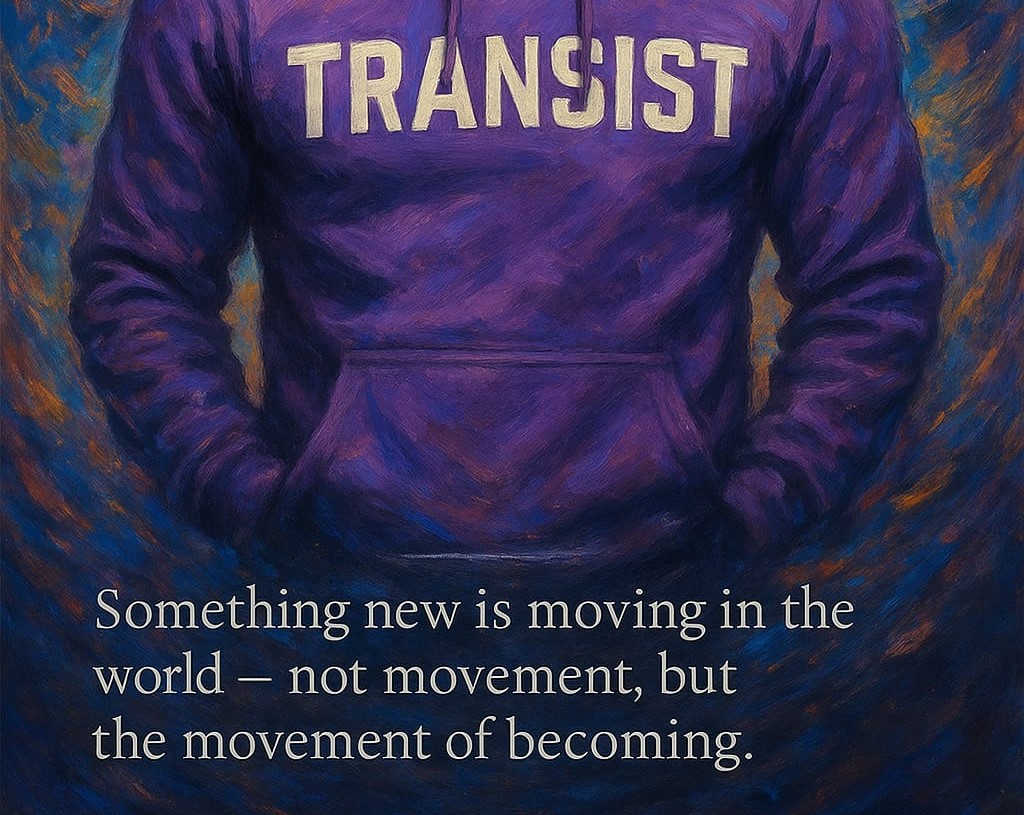
The question of becoming has never ceased to trouble philosophy (p. 2). It arises wherever identity is destabilized, at any moment when the human being ceases to be perceived as a stable essence and becomes a process, a transition, a movement (p. 2). "Becoming TransiSm" is not a theory in the classical sense, nor is it an ideology to be adopted, though it is an authentic condition, existing and present (p. 2). It is the formulation of a state already underway: a gradual and inevitable transformation of the human body-mind into a transitional being—a being that no longer stabilizes in essence, but exists within a constant becoming (p. 2).
To think this process, one must navigate between different philosophical spaces which, despite their historical distance, converge in their rejection of the fixed being (p. 2). Nietzsche, Deleuze, Foucault, and Heidegger each offer an essential axis for understanding becoming—not as a mere abstraction, but as a living occurrence unfolding across generations (p. 2).
At the foundation lies Nietzsche's idea of the Eternal Return (p. 2). It should not be viewed merely as a metaphysical hypothesis, but as an ethical-existential demand: to affirm life to such an extent that we desire its infinite return (p. 2). Yet, this is not a return of the identical (p. 2). The return is a test of transformation (p. 2). What returns is not the same body, the same mind, or the same culture, but the very power of becoming, reorganizing itself again and again (p. 2).
Within this horizon, the human being is not a complete entity but a threshold (p. 2). The body and mind are subject to continuous processes of re-evaluation, change, and interpretation (p. 2). Over hundreds and thousands of years, this process accumulates (p. 2). This is not a linear progress, but a recurring differentiation (p. 2). Hence, it can be observed that the human being is already in motion—already "transi" (in a transitional state)—even before being defined as such (p. 2).
Here enters Deleuze with his concept of becoming (p. 2). Becoming is not a transition from one identity to another, but a process that escapes identity itself (p. 2). It is not "to be something else," but to be-other, to be-multiplicity, to be-ungraspable (p. 2). The subject dissolves into a field of intensities, flows, and connections (p. 2).
"TransiSm," in this context, is not a new identity category, but a name for a condition where identity itself loses its centrality in favor of the process (p. 2).
Page 2
The body ceases to be a closed organism and becomes a plane of composition; the mind is no longer an internal essence, but a dynamic tapestry of forces (p. 3). Together, they form a body-mind continuum that is always in the making (p. 3).
Deleuze and Guattari's concept of "desiring machines" deepens this understanding (p. 3). Desire is not a lack, but production (p. 3). It is a force that connects bodies, technologies, signs, and environments (p. 3). In the current era—the era of desiring machines—the human being is increasingly intertwined with technological systems that expand, dismantle, and reassemble the body-mind (p. 3).
This is not an external imposition, but the amplification of an internal process (p. 3). The human being has always been "machinic," composed of assemblages (p. 3). What changes is the intensity and visibility of the process (p. 3). Technology does not create becoming; it accelerates and exposes it (p. 3).
Foucault allows us to understand how this process is mediated through culture (p. 3). The body and mind are not merely biological or metaphysical entities, but also products of discourses, institutions, and forces (p. 3). "The care of the self" is simultaneously a site of domination and of possibility (p. 3).
Hence, Becoming TransiSm is not only a natural evolution, but also a cultural-political process (p. 3). Norms of gender, identity, and normalcy are continuously produced and destabilized (p. 3). The emergence of fluid, hybrid, and transitional subjectivities exposes the instability of these norms (p. 3).
The "transi" condition is thus both an ontological event and a cultural event (p. 3). It is the moment when the human being ceases to view themselves as a fixed subject within a given order, and begins to operate within the transformation of the order itself (p. 3). For this, an inquiry is required—a critical encounter with the self and its conditions (p. 3).
Heidegger returns us to the question of Being through time (p. 3). The human being (Dasein) is not a fixed presence, but a being-toward (p. 3). It exists as an openness to possibilities (p. 3). Time is not a sequence of moments, but the horizon within which Being reveals itself (p. 3).
In this context, Becoming TransiSm is a temporal manifestation of the body-mind (p. 3). It is the recognition that the human being is always "ahead of itself," always in the process of being-what-is-not-yet (p. 3). The "transi" is not a deviation from Being, but its deepest expression (p. 3).
Page 3
The concept of "care" (Sorge) becomes central (p. 4). This is not merely preservation, but an engagement in one's own becoming (p. 4). It is a responsibility toward the openness of existence (p. 4). Within the framework of TransiSm, care expands to the body-mind as a single, unfolding unit (p. 4).
From the encounter between these perspectives emerges a new understanding of the human condition (p. 4). The separation between body and mind dissolves (p. 4). These are not two essences, but two aspects of a single process (p. 4). This process is not accidental, but bears a necessity—not a deterministic necessity, but a necessity of becoming (p. 4).
The development of the body-mind as a homogenous continuum is not merely a future possibility, but an emerging reality (p. 4). What changes is the degree of awareness and the capacity to operate within it (p. 4). TransiSm is the name given to this awareness—the moment when becoming becomes conscious of itself (p. 4).
In the era of desiring machines, this awareness becomes particularly urgent (p. 4). The integration between human and machine, the shaping of identity through digital and biological means, and the fluidity of social categories—all point to a condition where stability ceases to be the norm (p. 4).
This is not a loss, but an opportunity for a new order—an order that rests not on fixed identities, but on dynamic relations (p. 4). The body-mind becomes a site of perpetual negotiation, experimentation, and creation (p. 4).
Becoming TransiSm is not a choice in the ordinary sense (p. 4). It is a necessity arising from the very structure of existence (p. 4). The question is not whether we shall become, but how we will relate to this becoming (p. 4). Will we resist it, in an attempt to preserve stability? Or will we operate within it, through care, inquiry, and creation? (p. 4)
The answer is not given in advance (p. 4). It is actualized in life itself (p. 4). TransiSm is not a destination, but a movement—a transition unfolding in time, in culture, and in the depths of the body-mind (p. 4).
In this movement, the human being does not disappear—they change (p. 4). They become other than what they were, without stabilizing into what they will be (p. 4). This is not the loss of the human, but its amplification: the recognition that to be human means to be always in transition (p. 4).
Becoming TransiSm is, ultimately, an affirmation of this condition—an acceptance of becoming as the fundamental form of existence, and a commitment to operate within it fully: philosophically, culturally, and existentially (p. 5).
Brief Bibliography: (p. 5)
Friedrich Nietzsche, Thus Spoke Zarathustra; The Gay Science (p. 5)
Michel Foucault, The History of Sexuality; The Care of the Self (p. 5)
Martin Heidegger, Being and Time (p. 5)
Transis
Transis first appeared as a contemporary mythological figure — a different kind of superhero. Not one based on power, victory, or resolution, but on transition, imitation, and suspension. Transis emerged from a rupture: a rupture of identity, language, and politics, as a response to a world that demands binary decisions while reality itself refuses to stabilize
However, Transis’s story was erased from mythology. Not as a failure, but as a direct result of incompatibility: a figure that cannot be categorized, that is not loyal to a single origin, and that does not serve a stable narrative. This erasure is not the end of the story, but its very condition. Transis exists precisely where myth is interrupted, distorted, and forgotten
The mythological framework of Transis was first presented through an animated comic video, dubbed in English. Rather than offering a classical “origin story,” the video proposes an open myth: a sequence of transitions between male and female, between human and image, between personal voice and collective voice. It is an attempt not to preserve Transis, but to allow Transis to appear — and to disappear again
Transism – a movement of identities in transition
The Transism movement emerged following the work “Male and Female of Trump.” Not as a direct political reaction, but as an observation of a deeper mechanism: the enforcement of binary identities, the fixation of meaning through power, and the transformation of discourse into a tool of decision rather than a space for thought
Transism does not seek to propose a new identity. Instead, it recognizes identity as an ongoing process of becoming. It is an artistic and conceptual mode of thought grounded in the understanding that categories do not disappear — but they cease to be final
Transism operates through five conceptual seeds
Identity as continuous becoming, not a closed definition
Imitation as a critical act, not faithful reproduction
Failure as a creative space, not an error to be corrected
The body as a site of thought, not merely a representational tool
Transition as a permanent mode of existence, not a temporary stage
Transism engages with identities in transition – gendered, political, linguistic, and cognitive – and refuses to close them into a single position
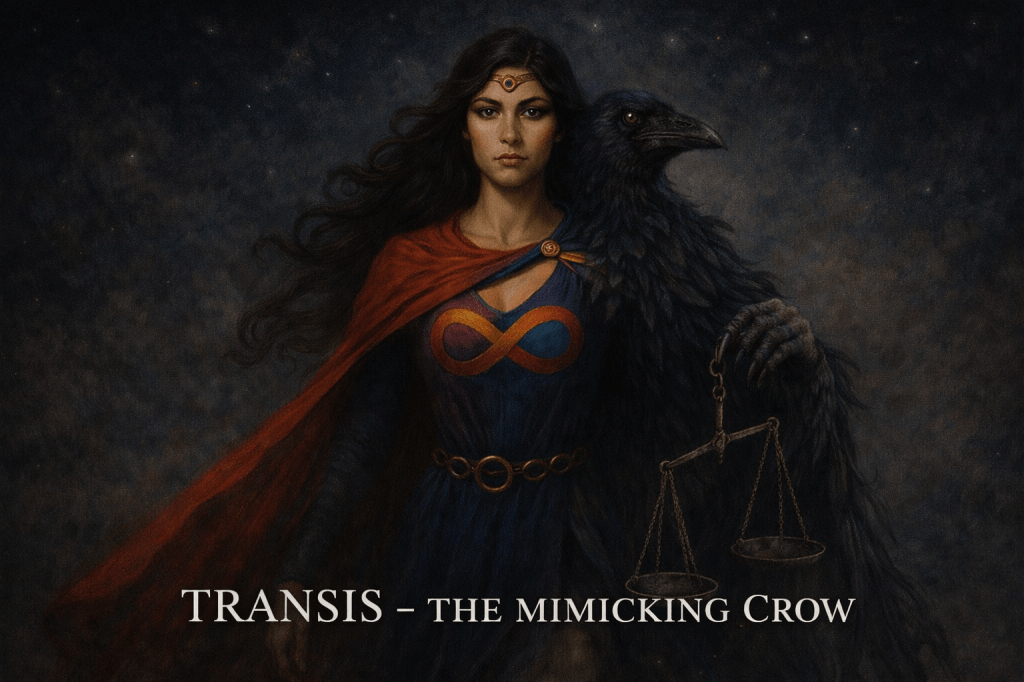
Transis – the Mimicking Crow
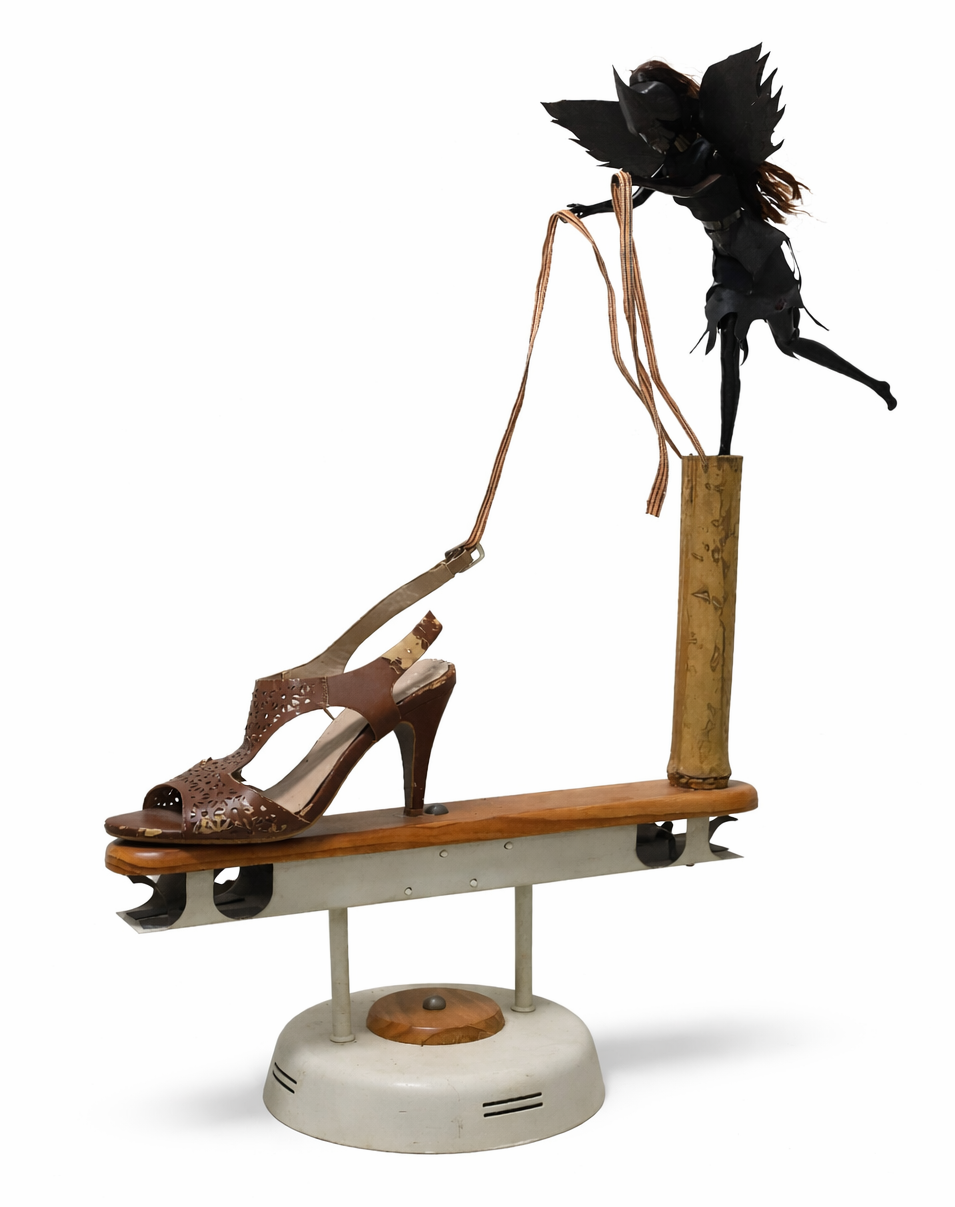
TRANSIS, The Chariot, Ilan Moyal
Recently, against the backdrop of the noise produced by boycotting states – and the silence that followed – Transis reappears in a new form: the Mimicking Crow
The crow is a bird that does not produce an “original” song. Its power lies in mimicry: absorbing sounds from its environment, repeating them, and at times distorting them. Mimicry here is not fidelity to a source, but an act that exposes the mechanism behind the voice itself
As Transis-the-Mimicking-Crow, the figure does not express an opinion and does not offer resolution. Its role is to echo the gap between noise and silence: between loud declarations and the legitimacy produced precisely through non-speech. It does not judge, but reflects repetition, automation, and the failure between voice and responsibility. The crow does not distinguish between truth and falsehood, between original and copy, between male and female. It operates precisely where such distinctions cease to function — forcing a renewed act of listening
Performance | Transis – The Mimicking Crow
A live performance will take place on the opening night of the exhibition Eurovision in Disaster
The performance operates as an open laboratory, engaging body, voice, and consciousness as processes in formation
It is not representational and does not function as a gesture or reenactment
Rather, it introduces interruption
imitation without fidelity to an origin
and vocalization detached from consensus
The action will occur once, without prior documentation and without a predetermined outcome. The identity of the performing artist will remain undisclosed