
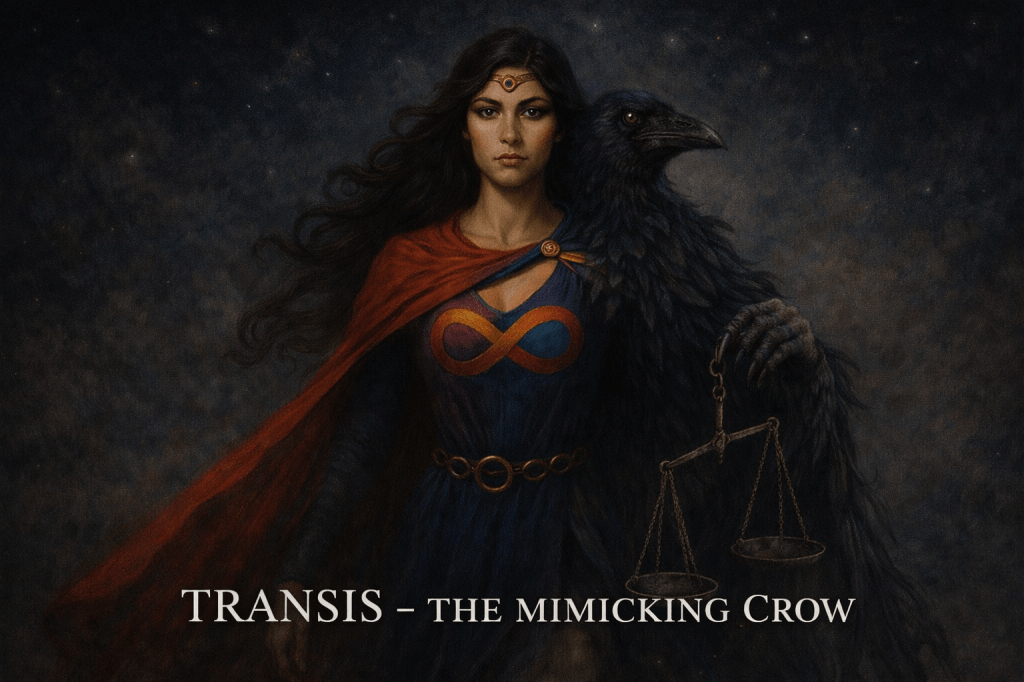
Transis first appeared as a contemporary mythological figure — a different kind of superhero. Not one based on power, victory, or resolution, but on transition, imitation, and suspension. Transis emerged from a rupture: a rupture of identity, language, and politics, as a response to a world that demands binary decisions while reality itself refuses to stabilize
However, Transis’s story was erased from mythology. Not as a failure, but as a direct result of incompatibility: a figure that cannot be categorized, that is not loyal to a single origin, and that does not serve a stable narrative. This erasure is not the end of the story, but its very condition. Transis exists precisely where myth is interrupted, distorted, and forgotten
The mythological framework of Transis was first presented through an animated comic video, dubbed in English. Rather than offering a classical “origin story,” the video proposes an open myth: a sequence of transitions between male and female, between human and image, between personal voice and collective voice. It is an attempt not to preserve Transis, but to allow Transis to appear — and to disappear again
Transism – a movement of identities in transition
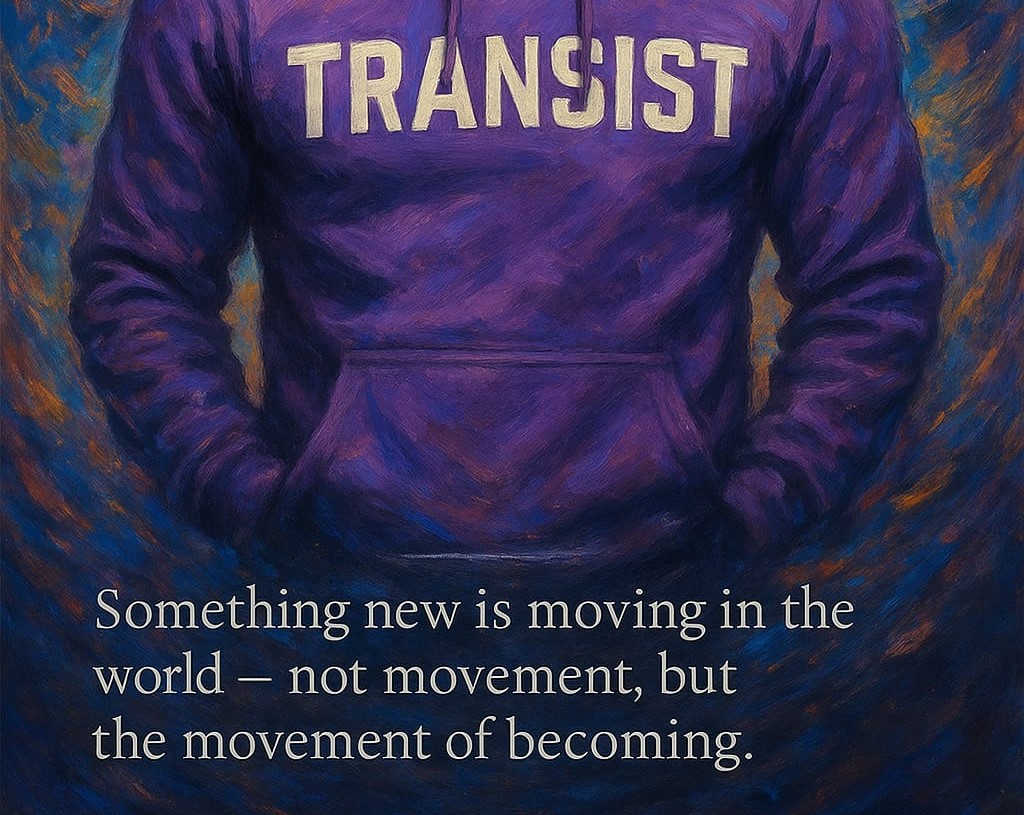
The Transism movement emerged following the work “Male and Female of Trump.” Not as a direct political reaction, but as an observation of a deeper mechanism: the enforcement of binary identities, the fixation of meaning through power, and the transformation of discourse into a tool of decision rather than a space for thought
Transism does not seek to propose a new identity. Instead, it recognizes identity as an ongoing process of becoming. It is an artistic and conceptual mode of thought grounded in the understanding that categories do not disappear — but they cease to be final
Transism operates through five conceptual seeds
Identity as continuous becoming, not a closed definition
Imitation as a critical act, not faithful reproduction
Failure as a creative space, not an error to be corrected
The body as a site of thought, not merely a representational tool
Transition as a permanent mode of existence, not a temporary stage
Transism engages with identities in transition – gendered, political, linguistic, and cognitive – and refuses to close them into a single position
Transis – the Mimicking Crow
Recently, against the backdrop of the noise produced by boycotting states – and the silence that followed – Transis reappears in a new form: the Mimicking Crow
The crow is a bird that does not produce an “original” song. Its power lies in mimicry: absorbing sounds from its environment, repeating them, and at times distorting them. Mimicry here is not fidelity to a source, but an act that exposes the mechanism behind the voice itself
As Transis-the-Mimicking-Crow, the figure does not express an opinion and does not offer resolution. Its role is to echo the gap between noise and silence: between loud declarations and the legitimacy produced precisely through non-speech. It does not judge, but reflects repetition, automation, and the failure between voice and responsibility. The crow does not distinguish between truth and falsehood, between original and copy, between male and female. It operates precisely where such distinctions cease to function — forcing a renewed act of listening
Performance | Transis – The Mimicking Crow
A live performance will take place on the opening night of the exhibition Eurovision in Disaster
The performance operates as an open laboratory, engaging body, voice, and consciousness as processes in formation
It is not representational and does not function as a gesture or reenactment
Rather, it introduces interruption
imitation without fidelity to an origin
and vocalization detached from consensus
The action will occur once, without prior documentation and without a predetermined outcome. The identity of the performing artist will remain undisclosed
 TRANSISM